
Leo Fordham and Prof Elli Leadbeater. 16 July 2026.
The intensification of farming has caused a loss of nesting and feeding habitat for bumblebees. Bumblebees need a varied diet of nectar and pollen throughout the season, but there aren’t many flowering crops, and those that do flower (e.g. oilseed rape) are only in bloom for a few weeks. Our research explored how bumblebee colonies on farmland are affected by the availability of food through the season. We placed bumblebee colonies on farms and gave some of them extra food, while others had to make do with what they could find. By comparing how well these colonies did, we could work out whether there was enough nectar and pollen available in these farmed landscapes for bumblebees to thrive.
Methods
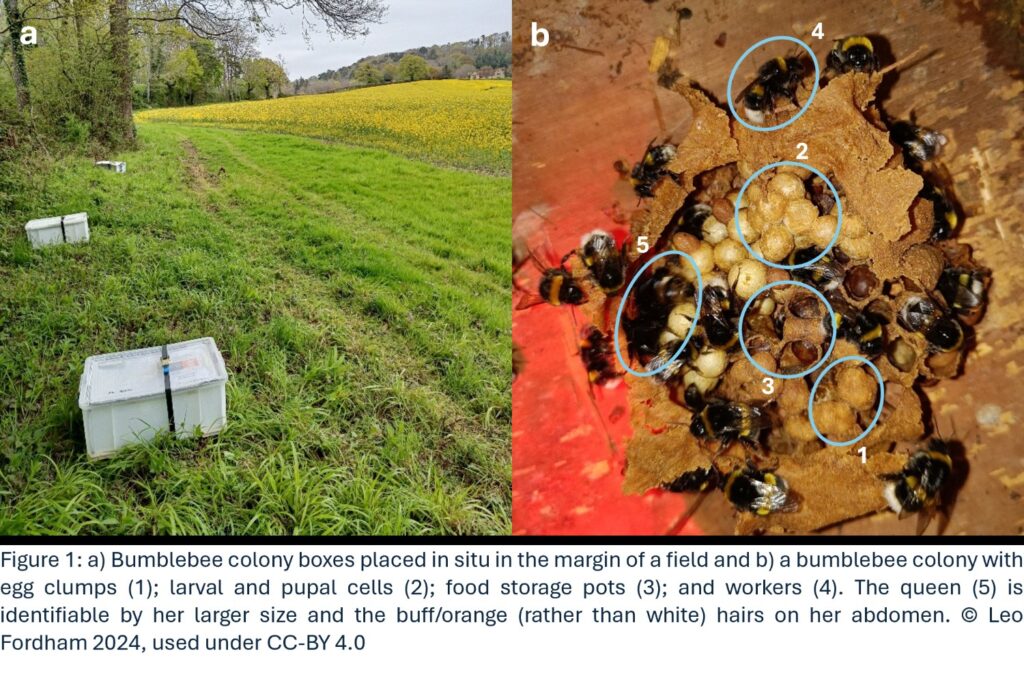
We included 20 farms in southeast England in our experiment. These were typically dominated by fields of wheat, barley, or oilseed rape, with uncropped areas mainly of ryegrass. We placed three lab-reared buff-tailed bumblebee colonies on each farm in April 2024 (see images).
For the first week we provided every colony with sugar water and a small amount of dry pollen, to ease the transition to the landscape. Following this, at each site:
• we gave one colony extra sugar water and pollen from April to mid-May only (the ‘early-fed’ colonies)
• we gave another colony extra sugar water and pollen from mid-May to June only (the ‘late-fed’ colonies)
• we gave no extra food to the third colony (the ‘control’ colony).
We tracked colony survival and success until each reached a natural conclusion. We focused on colony survival time; the number of worker bumblebees produced; and the number of males and new queens (reproductive individuals) produced. These are crucial to establishing next year’s colonies.
 Key findings
When we compared the colonies over the season, we found that:
• All colonies performed similarly during April and May.
• Colonies fed from May to June survived significantly longer – the others declined dramatically from this point.
• All the colonies produced few reproductive individuals.
• The number of workers counted didn’t vary significantly between the early-fed, late-fed and control colonies, but worker count was significantly lower following high weekly rainfall.
What does this mean for bumblebee conservation?
The colonies given extra food from May to June survived significantly longer than the others, indicating that there wasn’t enough food in local environments for bumblebee colonies to thrive during the early summer study period. All colonies performed similarly in April and May, suggesting that there was enough food in the landscape for colonies to survive at this time. However, the minimal colony growth during this period, and the subsequent dramatic decline of the early-fed and control colonies, shows that they were far from thriving. It’s likely, therefore, that there wasn’t enough food available to store and to grow the colonies during April and May.
UK spring 2024 was extremely wet, and we saw that high rainfall led to fewer workers. Rainfall is known to decrease pollen and nectar quality, yet another reason emphasising how important it is to tackle climate change and the extreme weather it causes.
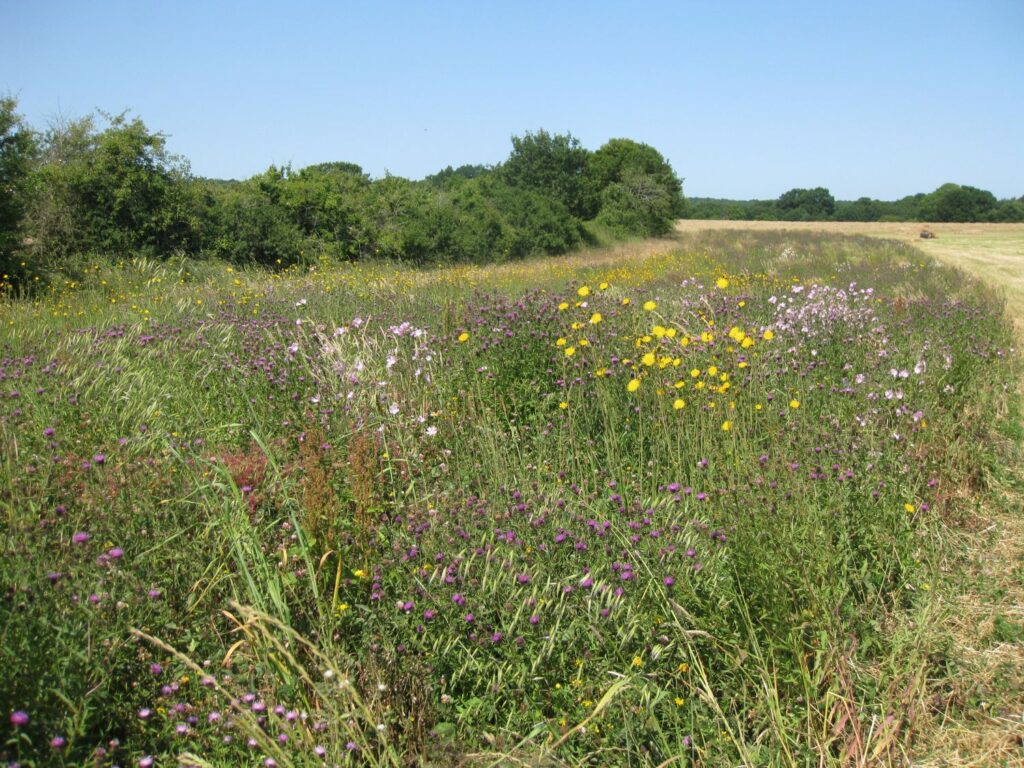
Overall, making space on farmland for plants that provide nectar and pollen in early summer is vital, but it’s just as important to provide food throughout the rest of the year. February to March, when bumblebee queens emerge from hibernation and start nestbuilding, is another time when sufficient food is crucial. Planting wildflower strips at field edges, (image below), or delaying and staggering the mowing and grazing of different areas, can create a patchwork landscape where there is always something in flower. Governments can encourage this through financial support for farmers to create this pollinator-friendly habitat.
Wildflower strip on edge of field
About the authors
Leo Fordham is a PhD student in the Department of Biological Sciences at Royal Holloway, University of London and the People and Nature Lab at University College London.
Elli Leadbeater is Professor of Ecosystems and Biodiversity Research at University College London.
They are the authors of this scientific article on the research.