
16 September 2026
By Senior Surveys Officer, Helen Dickinson
With the multi-organisational Species on the Edge (SotE) project drawing to a close in December 2026, thoughts are turning to the legacy of this fantastic initiative and how we carry forward its achievements in helping conserve some of Scotland’s rarest coastal species, including the Great Yellow bumblebee (Bombus distinguendus) and Moss carder bumblebee (Bombus muscorum).
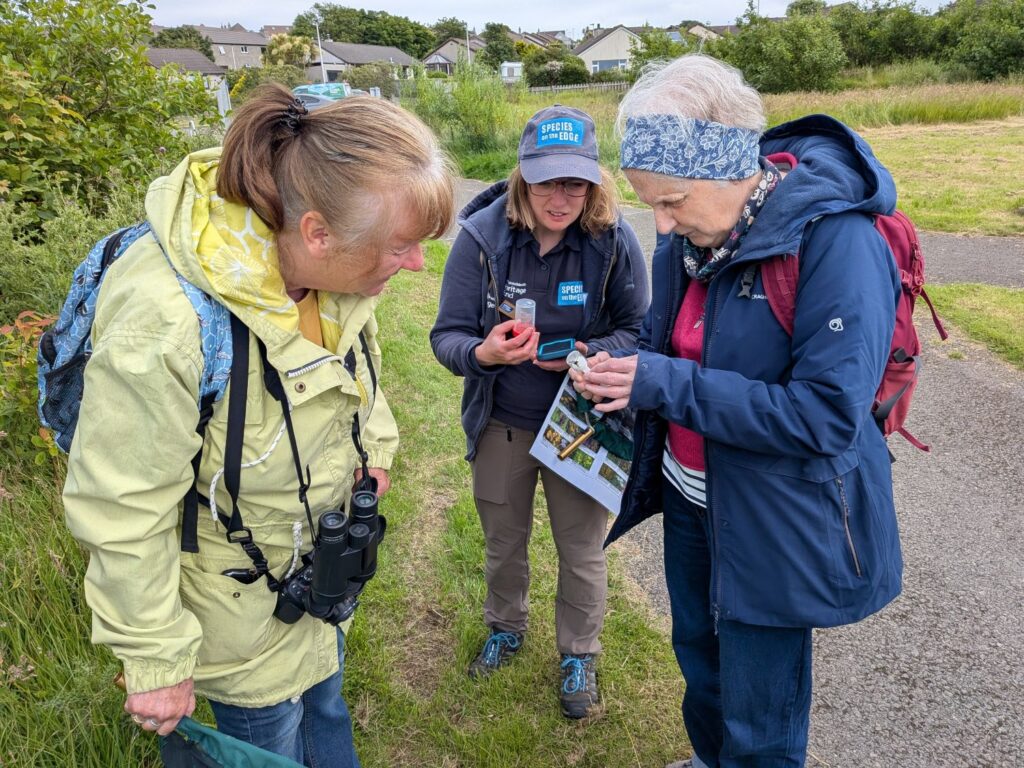
Orkney BeeWalkers ID session. Credit: Helen Dickinson
An important aspect of the project, and one particularly relevant to my role supporting our fantastic BeeWalk volunteers, has been the recruitment and training of local BeeWalkers to monitor bumblebees in these under-recorded areas. I have enjoyed collaborating with our Trust staff in the Outer Hebrides, and it’s been wonderful to work with the Plantlife and RSPB Species on the Edge Project Officers across the north coast, Orkney and Shetland.
Recently, I was invited by the Orkney and Shetland SotE teams to spend time with their BeeWalk volunteers. The aim was to help ensure they are aware of the long-term support available from the Trust’s BeeWalk team, making long term bumblebee monitoring one of the legacies of SotE.
Traditionally, remote areas with few people can be challenging to cover for monitoring programmes. After four years of dedicated effort from Project Officers in these locations, it is hugely important that we retain these fantastic volunteers, ensuring they feel supported and motivated to continue monitoring bumblebees long into the future.
Both Orkney and Shetland still support precious areas of flower-rich coastal grassland, providing habitat for some of our rarest bumblebee species. Orkney is a particularly important area for monitoring one of Britain’s rarest bumblebees, the Great Yellow bumblebee. The species now survives only in small populations in the Hebrides, along Scotland’s north coast and Orkney. To better understand how these populations are faring, long-term monitoring is essential.
I was incredibly lucky to see the species during my visit, only the second time I have encountered it in my 11 years with the Trust. It is a truly striking bumblebee and is never encountered in large numbers, making every sighting important.
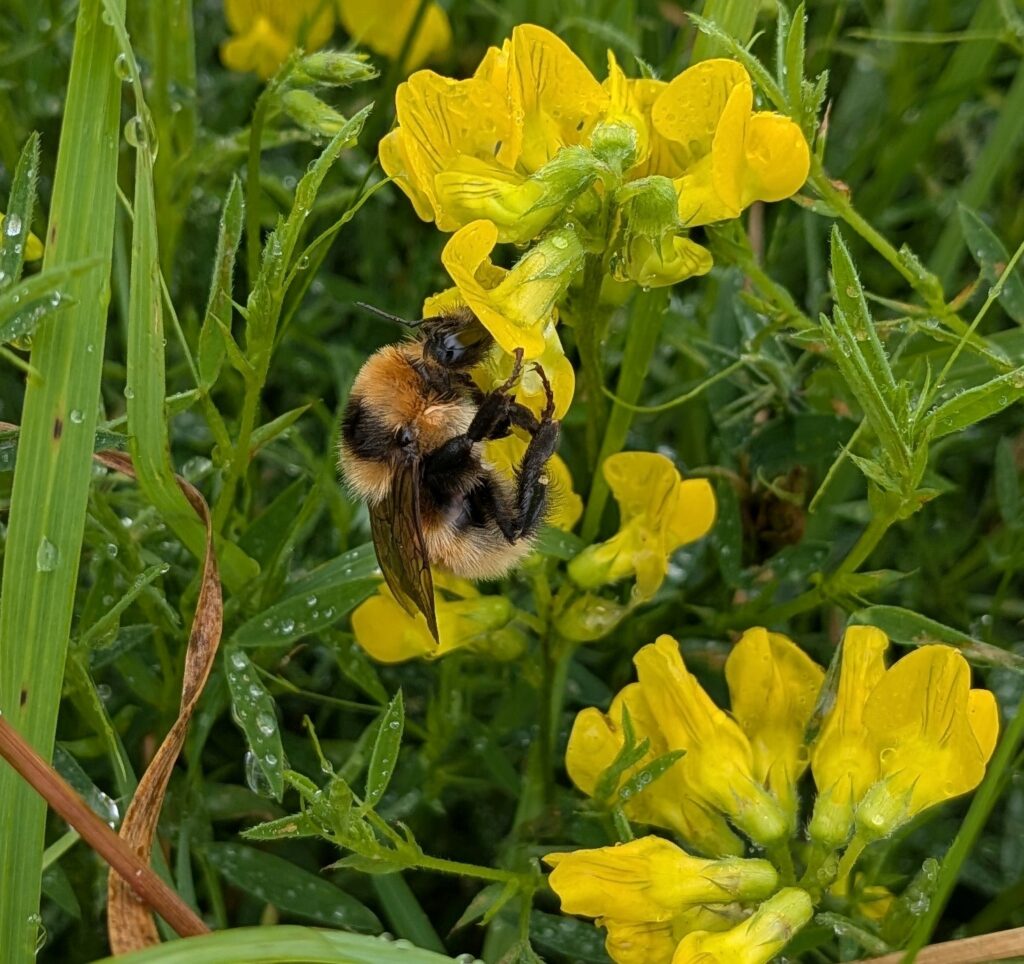
Great Yellow bumblebee. Credit: Helen Dickinson
The Moss carder bumblebee is also a priority species and was seen in abundance thriving in Orkney’s beautiful coastal grasslands and wildflower-rich roadside verges.
Although records of rare species are vital, it is equally important to understand how our more common bumblebee species are faring in these locations.
I spent a wonderful day with members of Orkney’s BeeWalk team (coincidentally several of whom were also called Helen!) discussing bumblebee ecology and identification tips while celebrating the fantastic increase in transects and records achieved since Helen Cromarty, RSPB SotE Project Officer, began recruiting and supporting local surveyors.
We were also delighted to be joined by local MSP Liam McArthur, who has recently become the Nature Champion for the Great Yellow bumblebee. He spent time with myself and Darryl Cox, the Trust’s Senior Science and Policy Officer, learning how to catch and identify this rare species.
I then made the journey to Shetland, a 12-hour ferry crossing, where I was greeted by dozens of the distinctive island form of the Moss carder bumblebee, known locally as the Shetland bumblebee, a subspecies of the Moss carder (Bombus muscorum ssp. agricolae) found only in Shetland and the Hebrides. This beautiful bumblebee was by far the most numerous species I encountered during my visit and much easier to identify than mainland Moss carders, which can be notoriously difficult to distinguish from the Common carder bumblebee (Bombus pascuorum).
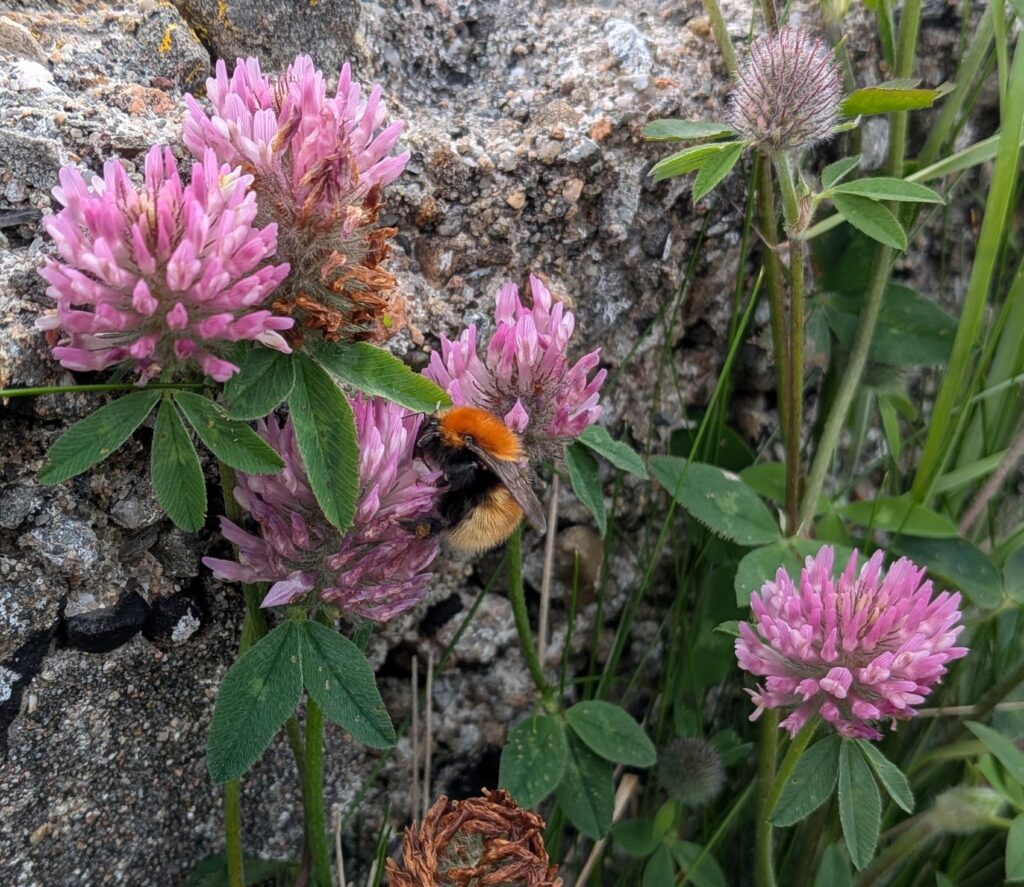
Shetland form Moss carder bumblebee queen. Credit: Helen Dickinson
Once again, I was able to spend valuable time with the local BeeWalk team, alongside Becca, the RSPB SotE Project Officer, and Gareth Powell from Shetland Amenity Trust. Together we discussed survey techniques and identification skills while exploring some fantastic bumblebee habitat and celebrating again a huge increase in local monitoring.
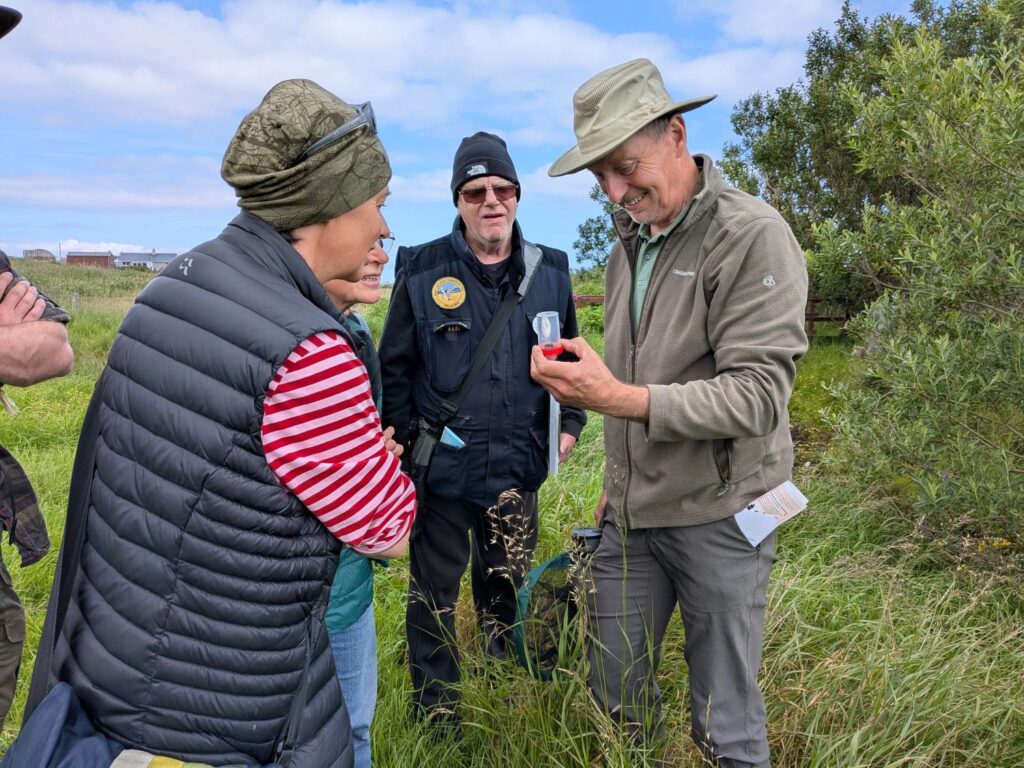
Group of Shetland BeeWalkers. Credit: Helen Dickinson
During my visit we recorded four of Shetland’s six bumblebee species: Shetland bumblebee, Heath bumblebee (Bombus jonellus), Garden bumblebee (Bombus hortorum) and White-tailed bumblebee (Bombus lucorum s.l). The Heath bumblebee was particularly distinctive, with its characteristic peachy-orange tail compared with the white-tailed form typically seen on the mainland. I also came across an Early bumblebee (Bombus pratorum) male in Lerwick: this species is a new arrival on Shetland and only common in the capital.
Thanks to the support of RSPB staff, I managed to visit the northernmost beach in Shetland (involving two short ferries to Unst), where I recorded both the Shetland Bumblebee and a single White-tailed Bumblebee. For now, these are the most northerly bumblebee records in Britain!
A huge thank you to the RSPB Species on the Edge staff and the local BeeWalk volunteers for introducing me to some beautiful bumblebees and making me feel so welcome. It is always a pleasure to spend time with our incredible BeeWalkers, whose enthusiasm and dedication are helping to secure the future of bumblebee conservation through the monitoring of their local patch.
As Species on the Edge draws to a close, it is reassuring to know that the foundations have been laid for long-term bumblebee monitoring in these important island communities. The skills, knowledge and enthusiasm developed through the project will continue to provide valuable data for years to come, ensuring that Scotland’s rarest bumblebees remain firmly on our conservation radar.