
Dr Gabriella Süle. 11 February 2026.
How can we best support pollinators in urban areas? We set out to answer this question by synthesising evidence from research carried out across Europe. We collected and re-analysed 28 datasets covering 1,051 sampling sites across 12 European countries.
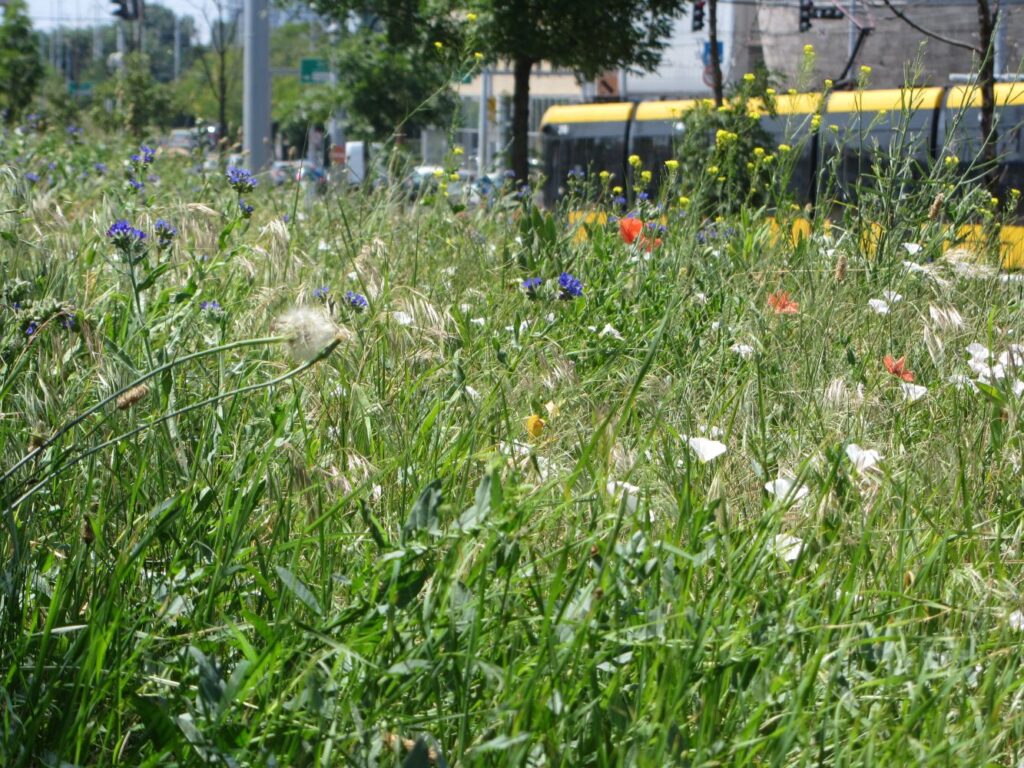
Our analysis compared the standard approaches to managing urban spaces with a range of interventions to support pollinators. These took place in parks, road verges, grasslands and gardens and included:
- Flower sowing
- Mowing once or twice per year
- Abandonment (leaving green spaces undisturbed)
- Combined practices
Key findings
All the interventions had significant positive effects on vegetation height, and on abundance and species richness of insect-pollinated plants – increasing the availability of pollen and nectar for pollinators to feed on.
All pollinator groups responded positively to the interventions, but bumblebees and butterflies benefited most.
Flower sowing was the most impactful intervention. This increased the abundance and species richness of insect-pollinated plants, the abundance of bumblebees, and the total number of pollinators.
Among urban habitats, roadside verges were most strongly improved by the interventions, perhaps because they were the least biodiverse places to begin with.
The strongest effects were observed in Northwestern Europe, suggesting regional variation in intervention success.
Knowledge gaps
Only a small proportion of the datasets we analysed provided information on the age of the intervention. Most datasets covered either 1 or 2 years with only two covering 3 years.
Studies assessing the longer term impact of interventions are needed. More studies are also needed on novel interventions – for ground-nesting insects, for example – and on Mediterranean urban habitats, which are currently underrepresented.
What does this mean for bumblebees?
Our findings highlight the value of urban areas for bumblebee conservation: bumblebees benefited most from the interventions studied.
Most interventions aimed to provide flowering plants to supply pollen and nectar – these are important, but have limitations as they don’t meet all the needs of bumblebees and other pollinators. For example, tall and dense vegetation can increase feeding opportunities but decrease nesting sites for species that nest underground, such as the Buff-tailed bumblebee.
Interventions aiming to increase nesting sites are uncommon and therefore under-researched. More research is needed on creating patches of bare soil, which can be used for hibernation as well as nesting. Diversity in habitats is key to meeting the full range of pollinator needs.
Since the most impactful intervention – flower-sowing – is also the most expensive, a next-best option would be to reduce mowing to once or twice a year.
‘Mosaic mowing’ – mowing at different times in different areas and cutting to different heights – can help increase diversity by creating a mosaic of different vegetation types.
The cost of flower sowing can also be reduced by using ‘green hay’ – wildflowers and grasses cut from a nearby healthy, species-rich meadow just before they set seed, which is then spread on the prepared site.
Combining mosaic mowing with overseeding areas with wildflower seeds would be a cost-effective and sustainable approach. Ultimately, evidence-based urban biodiversity strategies, adapted to local requirements, are key to helping urban pollinators.
About the author
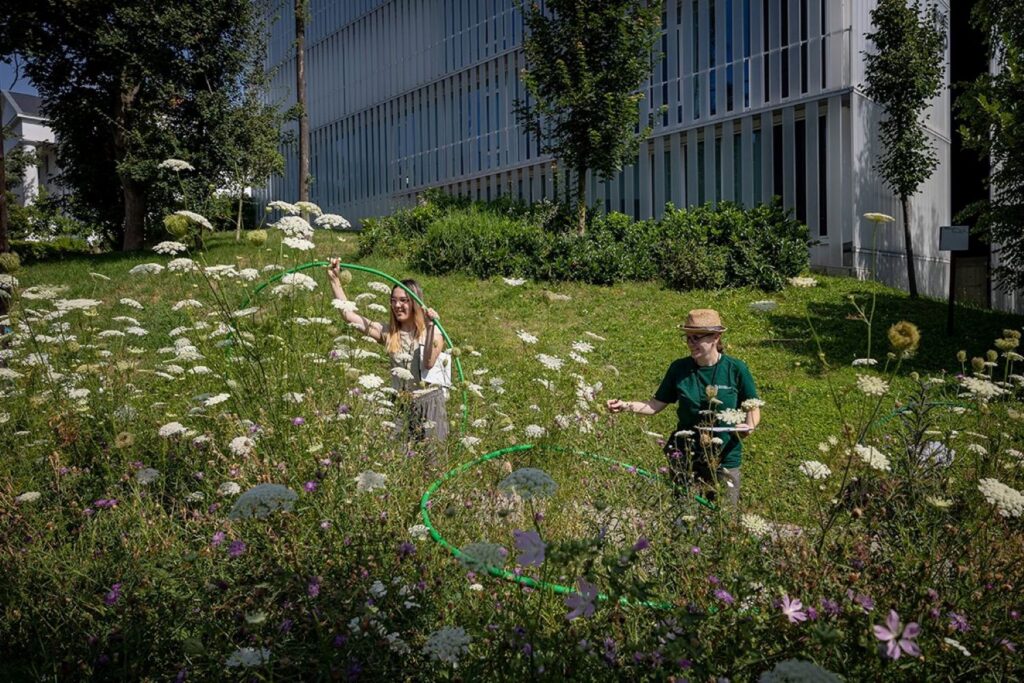
Gabriella Süle (above, right) is a research fellow in Lendület Ecosystem Services Research Group, based in the Institute of Ecology and Botany at the HUN-REN Centre for Ecological Research, Vácrátót, Hungary. She is the lead author of this scientific article on the research.
First photo credit: Viktor Szigeti © HUN-REN Centre for Ecological Research.
Second photo credit: Márton Kállai © HUN-REN Centre for Ecological Research.