
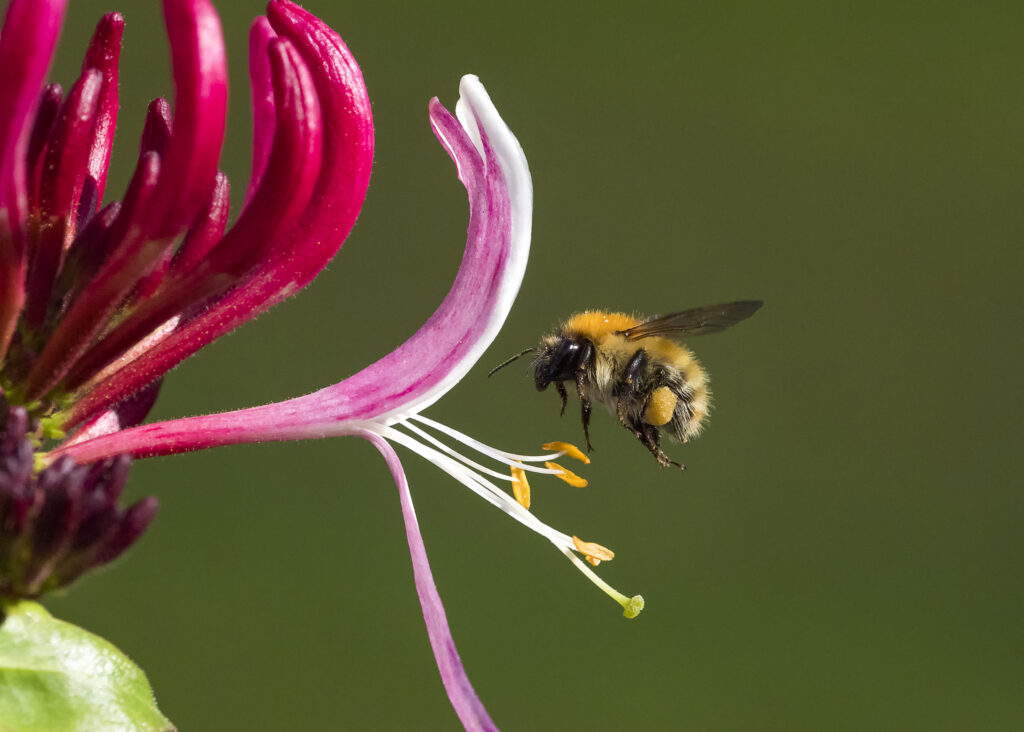
Moss carder bumblebee. Credit: David Geddes
22 September 2026
The Bumblebee Conservation Trust is leading an ambitious three-year national project to help recover populations of one of England’s most threatened bumblebees, the Moss carder, made possible thanks to £531,915 of funding from Natural England’s Species Recovery Programme.
The Moss carder bee recovery in England project is one of 130 across England that have received a share of £60 million as part of the programme. More than 350 threatened species will benefit from the largest ever investment in recovering England’s wildlife, as part of the government’s “Wild Again: Restoring England’s Wildlife” initiative.
The project, which is planned to run until March 2029, will be delivered by the Bumblebee Conservation Trust alongside the University of Cambridge. Work will focus on three important landscapes: Kent’s coastal grasslands, grazing marshes and sea walls; Cornwall’s coastal grasslands, dunes and heathland; and the upland fringe landscape of the North Pennines.
Once widespread in the UK, the Moss carder bumblebee is now in decline and is largely found in small, fragmented populations. The species is distinctive, with a velvety covering of ginger-yellow hairs across its body and no black hairs, unlike some similar bumblebees.
Habitat loss and fragmentation are likely to have a bigger impact on the Moss carder bumblebee than many other species, as it typically forages closer to its nest than most other bumblebees, and these small areas must provide all the food needed by the nest.
Alongside experts at the University of Cambridge, the Bumblebee Conservation Trust will be working with local landowners and communities to trial small-scale habitat interventions to identify those that work well for the Moss carder bumblebee, while gaining a better understanding of its behaviours and needs.
Amy Plowman, Head of Conservation and Science at the Bumblebee Conservation Trust said “This is a hugely exciting and ambitious three-year project that gives us a real opportunity to turn the tide for one of the UK’s rarest bumblebees. The funding from Natural England’s Species Recovery Programme will bring together our conservation expertise, the research and knowledge of our university partners, and targeted action across these three important locations, to give this bumblebee the best possible chance of a more secure future”.
Professor Lynn Dicks, Agroecology Group, Dept of Zoology, University of Cambridge said “We’ll be applying some of the latest scientific advances in earth observation and conservation science to improve and evaluate the effectiveness of conservation for the Moss carder bumblebee. It’s brilliant to be working in partnership with the Bumblebee Conservation Trust, who will work with landowners and communities to translate our research findings directly into practical conservation actions on the ground”.
Speaking about the project, Tylan Berry, Senior Officer at Natural England said “The Moss carder bumblebee is one of England’s most threatened pollinators, and we are delighted to support the Bumblebee Conservation Trust’s work to help secure its future through funding from our Species Recovery Programme. Projects like this demonstrate how targeted investment can support practical conservation action on the ground
The Species Recovery Programme is helping conservation organisations, researchers, land managers and local communities take practical action to halt species decline and support nature recovery across England.”
Visit the project page for further details.
Notes
The Natural England grant is funding all three areas of this new project. The Cornwall arm of the project is building on the successes of a similar previous project in that area which was funded by Kelly’s of Cornwall (Froneri UK) and Big Give donors. Both these funders are continuing to fund this part of the project in 2026
Including in-kind contributions (from University of Cambridge and volunteers), the total cost of the project is £907,242.