
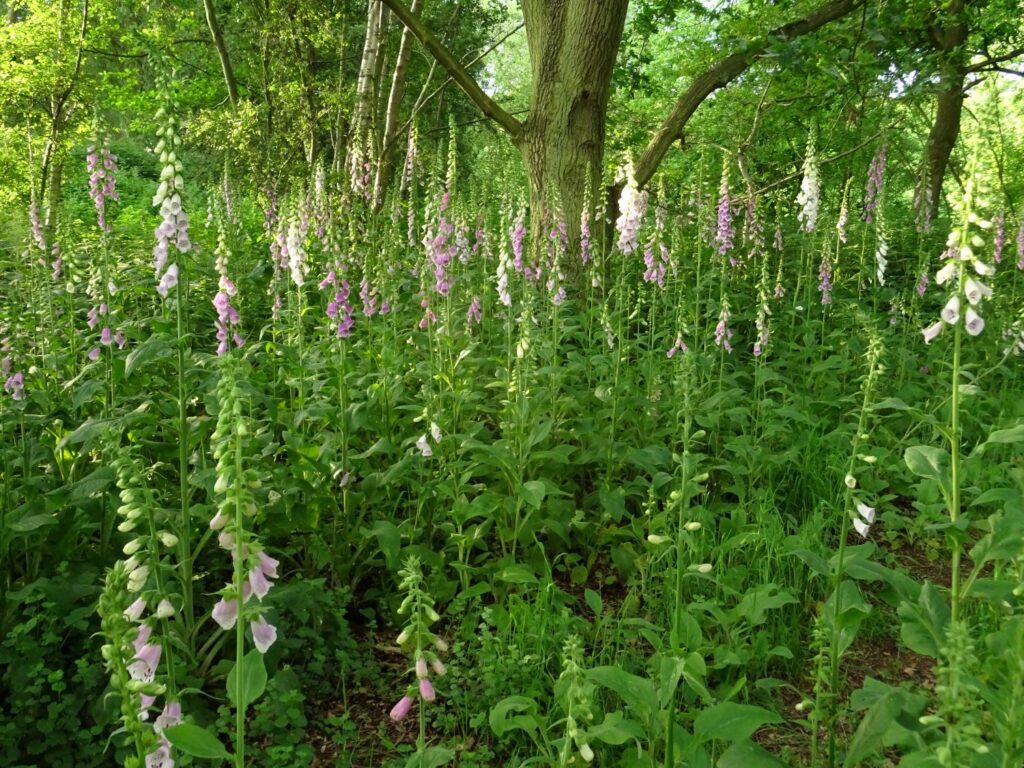
Foxgloves carpeting a woodland floor. Credit: Bex Cartwright
Dr Océane Bartholomée. 13 May 2026.
Have you ever seen a bumblebee in woodland? Most people picture bumblebees flying across open, sunny grasslands. Yet it’s also possible to find these fluffy insects in the dim, scattered light beneath a forest canopy, where navigating and finding food can be visually challenging. We know that the ability to see well in dim conditions varies between different bumblebee species – so we decided to explore whether these different visual abilities influence which habitats and plants bumblebees visit.
Methods
We measured the visual abilities of fifteen different bumblebee species using a visual trait known as the eye parameter. Bumblebee species with higher eye parameters are more sensitive to light, allowing them to see well in dim conditions. Species with lower eye parameters are less sensitive to light, which means they’re better able to see fine detail in bright light.
We investigated whether species with higher light sensitivity were more often found in forests and in landscapes with greater forest cover. To go beyond navigation and explore foraging patterns, we also examined plant–pollinator interactions, testing whether light sensitive bees tend to visit plants that tolerate shade. We used data from nine years of nationwide bumblebee monitoring in Norway, covering both forests and grasslands. We also combined data on pollinator–plant interactions from a British database with data from a Swedish plant trait database.
Key Findings
The results revealed consistent patterns:
- Bumblebee species with higher light sensitivity were more frequently observed in forests and in landscapes with greater forest cover, while less light sensitive species better able to see detail in bright light were more common in open grasslands.
- When looking across entire bumblebee communities – that is, all species observed together at the monitoring sites – the average eye parameter increased with forest cover, suggesting that forest habitats and forested landscapes support communities with greater light sensitivity.
- Light sensitive species also tended to forage on shade-tolerant plants, indicating that their visual traits may align with the plants they visit. This suggests that these species may be able to both navigate and feed effectively in dim environments.
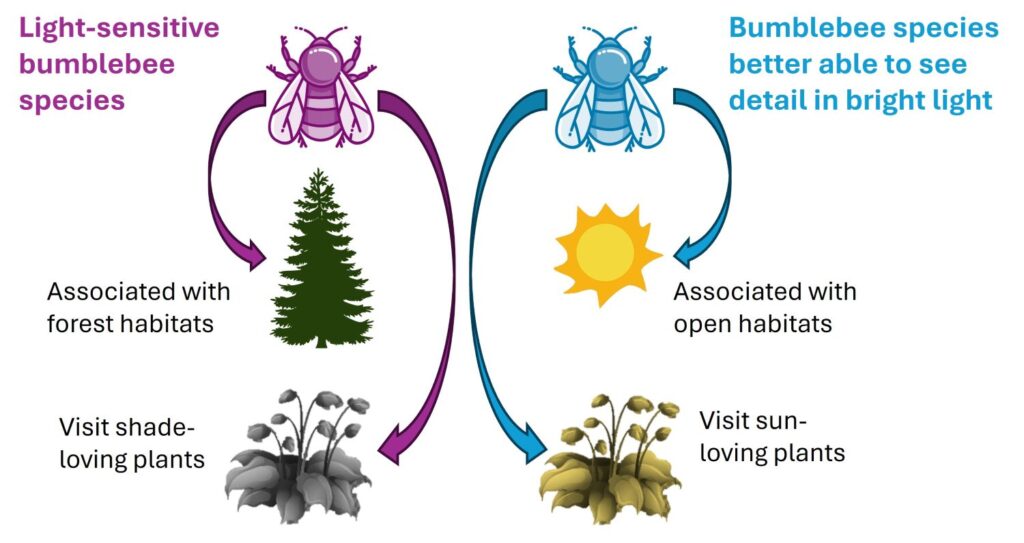
The results revealed consistent patterns. Credit: Océane Bartholomée
We can’t say from this data whether eye traits cause the species to use particular habitats. But the associations between light sensitivity and habitat use suggest that sensory traits may play a role in explaining bumblebee distribution. The study is limited by the fact that eye parameter measurements were available for only a few individual bees from each species. Thus, more data will be needed to confirm these patterns. Still, the consistency of the results implies a meaningful relationship between vision and habitat use.
What does this mean for bumblebee conservation?
Much scientific research on pollinator conservation has focused on the availability of food and nesting sites. Sensory traits, such as visual abilities, have so far been overlooked – even though they may also play a role in shaping how pollinators interact with their habitats and where they might be found.
Our findings highlight the value of forests as habitats for those bumblebee species able to navigate in dim light. Forests are often overlooked in pollinator conservation, yet the diversity of the forest floor provides habitats for light sensitive species and the shade-tolerant plants they pollinate. A mosaic of habitats – from sunny open grasslands to shaded forests – is needed for bumblebee conservation.
This means that conservation strategies should look beyond flowers and nesting sites and consider the sensory environments that shape pollinator communities. By understanding how bees experience their world, we gain new tools to anticipate their responses to environmental changes.
About the author
Océane Bartholomée is a researcher at the Department of Earth and Environmental Sciences, Lund University, Sweden.
She is the lead author of this scientific article on the research.