
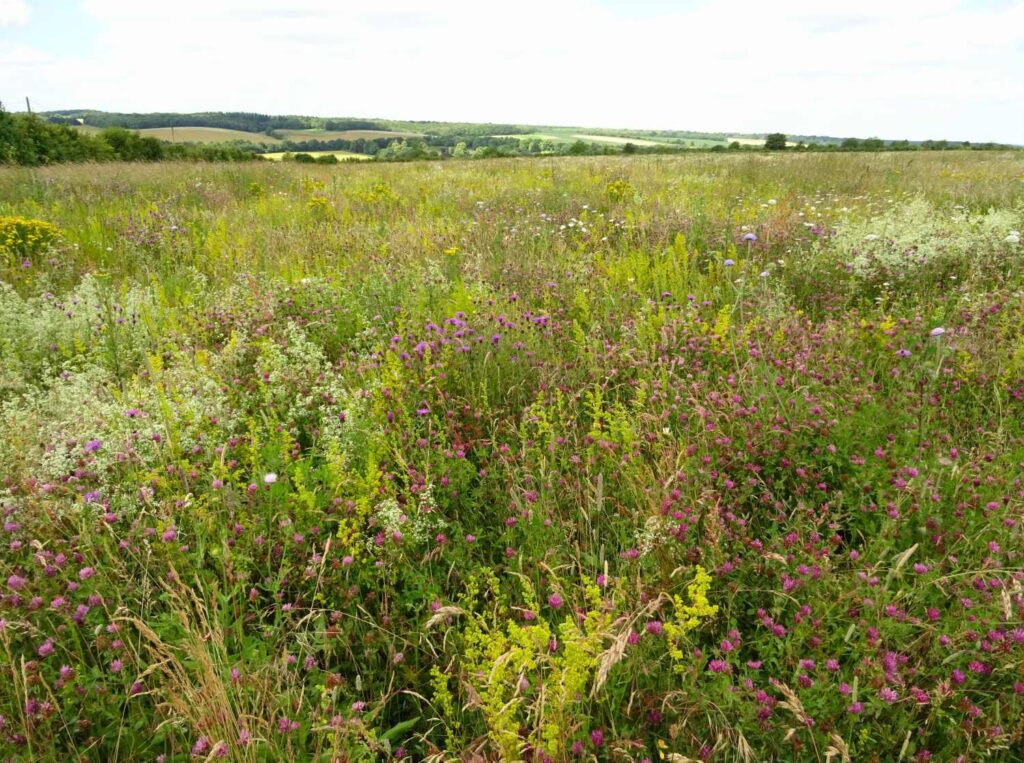
A farmer’s field of species-rich grassland. Credit: Bex Cartwright
27 March
In February, the government announced changes to the Sustainable Farming Incentive (SFI), a scheme which pays farm businesses and land managers in England to adopt or maintain environmentally beneficial, sustainable land management practices. These changes have reduced the number of actions that farmers can carry out in return for payment, which could see detrimental effects for bumblebees.
In this blog we’ll identify some of the most significant changes, discuss what these will mean for farmers and bumblebees, and also outline some of the positive options that still remain within the scheme.
Across much of England, bumblebees and other pollinators depend on the habitats that farmland provides. Well-managed native hedgerows, flower margins and diverse grasslands can all supply the nectar, pollen and nesting places bumblebees need throughout the year.
Bumblebees and other pollinators are often the unsung heroes of farm productivity. By pollinating many fruit, vegetable and forage crops, they act as an essential on-farm ‘service’, helping underpin yields, crop quality and long-term food and nutrient security. Their habitats also capture carbon, slow down and hold water to provide resilience against flood and drought events, and provide habitat for other beneficial groups such as natural pest predators, birds and other farm wildlife.
Many farms already support pollinators as part of everyday land management. Government schemes such as the Sustainable Farming Incentive (SFI) can help build on this by supporting actions that benefit soil, wildlife and water while still working alongside productive farming.
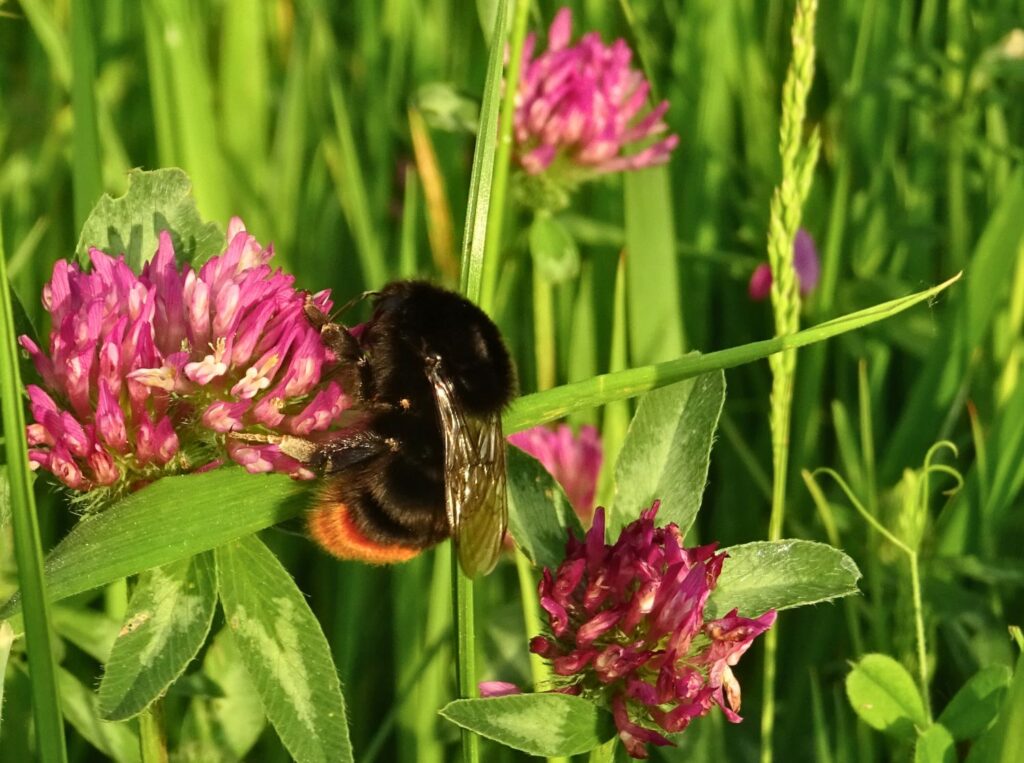
A Red-tailed bumblebee feeding on red clover. Credit: Bex Cartwright
Why bumblebees rely on farmland habitats
Many of the UK’s bumblebee species rely heavily on farmland habitats. Over the course of an active season (February–October), they need a continuous supply of nectar and pollen as well as undisturbed places to nest.
In early spring, queen bumblebees emerge from hibernation and need flowering plants to regain energy and nutrients in order to start new colonies. Flowering hedgerows, early legumes and flowering cover crops can be especially important at this stage.
As colonies grow through late spring and summer, colony workers collect large quantities of nectar and pollen to feed developing larvae. Wildflower meadows, flower-rich margins, clover-rich grasslands and well-managed herbal leys can provide vital resources during this period.
In late summer into early autumn, newly produced queens must build up fat reserves before hibernation. Late-flowering plants such as knapweed, clovers, ragworts and thistles are particularly important for this stage of the bumblebee life cycle.
Providing a mix of these habitats across a farmed landscape can help support bumblebee colonies throughout the year.
What has changed under SFI26?
The updated SFI offer has reduced the total number of options available by about a third, from 102 to 71. Some of the removed options supported the creation of vital nectar and pollen-rich habitats.
Specialised nectar and pollen mixes that were available under earlier versions of the scheme are no longer included. Some of these options were particularly important for bridging the March–May bumblebee ‘hungry-gap’ particularly in arable areas where flowering plants can be scarce.
The scheme has also removed incentives for several whole-farm planning actions, including Integrated Pest Management. While these actions did not directly create habitat, they helped support a more joined-up decision process and approach to soil, nutrient and pest management that could also benefit pollinators.
Support for providing vital nesting habitat for bumblebees have also been reduced through these changes. These were previously supported by tussocky margins and reduced grazing supplements which would encourage low intensity structurally diverse swards. Some of the SFI options with potential to support bumblebees directly or indirectly that have been removed:
- AHW1 – Bumblebird mix
- SOH2 – Multi-species spring-sown cover crop
- SOH4 – Winter cover crop following maize
- Soil/pest/nutrient planning actions
- Organic pollinator habitat options
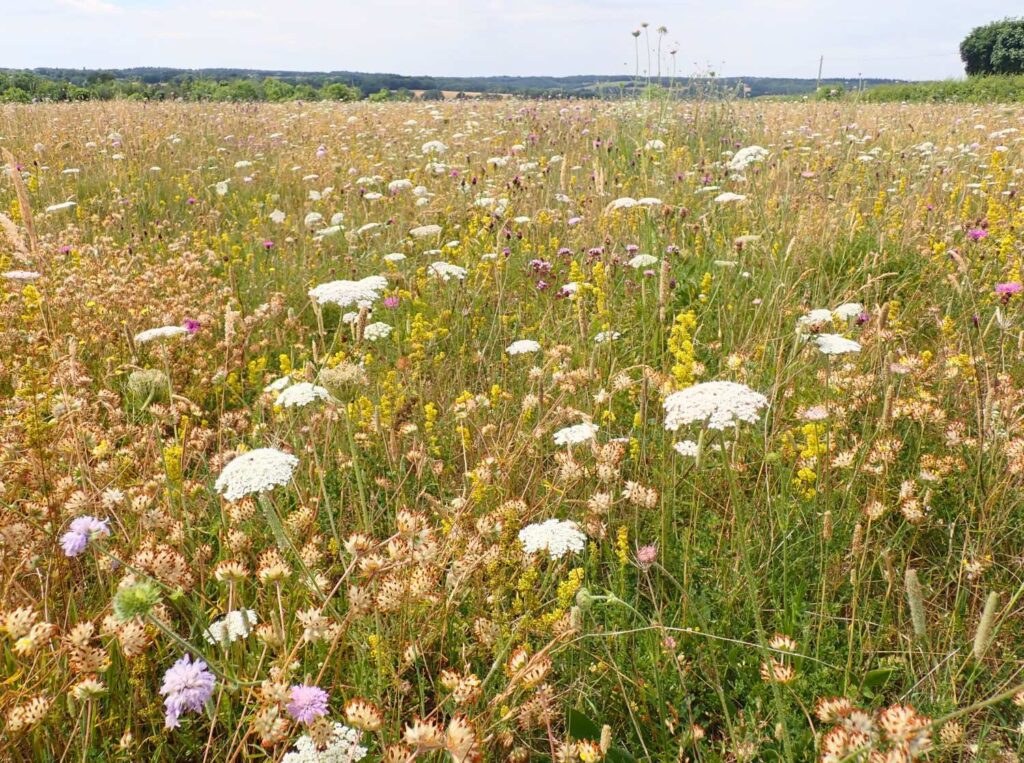
Species-rich grassland supports bumblebees and other pollinators. Credit: Bex Cartwright
GRH6 Management of species rich grassland
Another deeply worrying change is that support for managing species-rich grassland (GRH6) is no longer available within SFI. This is a very concerning step for bumblebee conservation and for the wider aims of nature recovery across farmland. These flower-rich grasslands are not just ‘nice-to-have’, they are among the most important and high-value habitats for bumblebees. Flower-rich meadows can provide a wide variety of nectar and pollen sources across the summer, supporting both common and rare species of bumblebee.
These high-value, species-rich grasslands also bring much wider benefits beyond pollinators. Their soils and complex root systems are capable of storing large quantities of carbon, improving soil structure and health and support better water infiltration making land more resilient to drought and heavy rainfall events, protecting our soils and our waterways. In losing this option, we lose far more than pollinator forage, we risk reducing opportunities for one of the most nature-positive land uses for biodiversity, carbon capture, cleaner water and long-term farm resilience.
The loss of this support and risk to these habitats represents a real setback for farmers who want to look after their highest-value grasslands while running a productive business. It is the biggest ecological loss for pollinators including bumblebees. GRH6 was one of the few SFI actions designed specifically for high-quality species-rich grassland, and it went some way to recognise the time, stock management and skills needed to get this right. For many farms, GRH6 offered a clear and realistic route to support the kind of meadows and grasslands that are now incredibly rare in England, habitats that have declined by over 97% over the last century.
Support for this type of habitat will now sit within the Countryside Stewardship Higher Tier scheme which is currently open only to invited applicants.
Payment Cap
Another change that may affect how farm businesses are able to plan habitat work is the introduction of a cap on SFI payments. For many farms, especially those managing larger areas of grassland or looking to take a whole farm approach, this cap could limit the amount of land that can be entered into pollinator-friendly actions.
Bumblebees don’t recognise field or farm boundaries, and they rely on extensive blocks of well-connected flower-rich habitat across a landscape. When farms are restricted in how much land can be included in the scheme, creating these joined-up habitats and landscapes becomes far more challenging.
This means that while individual margins and flower strips still play a role, the cap may make it more difficult to plan larger, more continuous areas of habitat or to work at scale with neighbouring businesses. In practice, the payment cap could reduce flexibility, limit long term planning, and make it harder to achieve the kind of landscape-scale connectivity that bumblebees need.
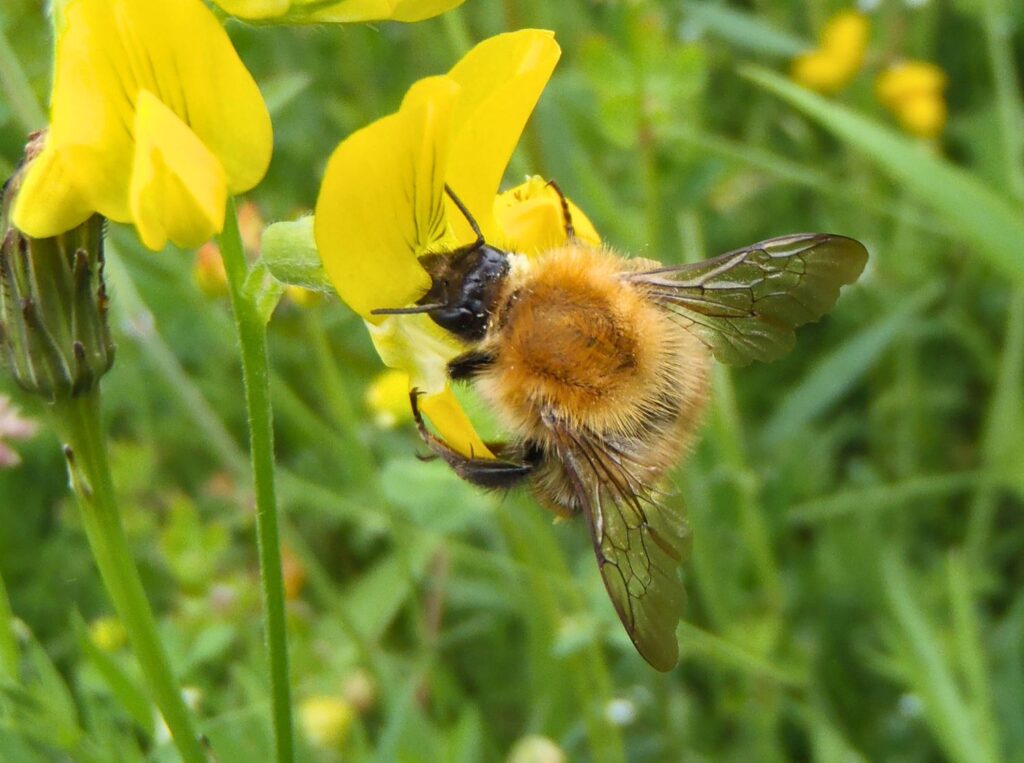
A Common carder bumblebee feeding on meadow vetchling. Credit: Bex Cartwright
Which options still support bumblebees?
Despite these changes, several SFI options can still provide useful resources for bumblebees and other insects when used across the farmed landscape.
CIPM2/IPM2 Flower-rich grass margins, blocks or in-field strips can provide nectar and pollen through much of the summer, particularly where diverse mixes are established along field edges or less productive areas. (Limited area action)
CAHL1/AHL1 Pollen and nectar flower mix designed to provide reliable nectar and pollen resource. Highly beneficial for bumblebees. (Limited area action)
CAHL2/AHL2 – Winter Bird Food (Arable) is primarily aimed at supporting birds through autumn and winter, but carefully selected flowering species, like mustard, sunflower and phacelia, can support bumblebees and other pollinators through the summer months. (Limited area action)
CAHL3/AHL3 Grassy field corners or blocks creates undisturbed tussocky grass areas, useful for nesting bumblebees. (Limited area action)
CIGL1/IGL1 Take improved grassland field corners or blocks out of management offers limited floral benefit unless species diversity is good, but can provide nesting opportunities for bumblebees. (Limited area action)
AHW11 Cultivated areas for arable plants creates bare ground to encourage germination of rare arable plants. Variable benefit for bumblebees but can be high depending on species composition and flower abundance (Limited area action)
CNUM3 Legume-rich fallow can also provide valuable forage mid-season. Plants such as red clover, white clover, bird’s-foot trefoil and vetches are especially attractive to many bumblebee species while also contributing to soil fertility.
CSAM3 – Herbal leys provides a mix of herbs, legumes and grasses which can support bumblebees when well-planned and managed while delivering benefits for soil health, livestock nutrition and resilience in grassland systems.
CHRW2 Hedgerow management supports a range of wildlife-sensitive routine hedgerow trimming and management actions. Rotational and incremental trimming encourages good hedgerow structure and allows flowering and fruiting. Highly beneficial for bumblebees.
SAM2/CSAM2, SOH3, IPM3/CIPM3. Where cover or companion crops are part of a farm cropping system, including flowering species, like phacelia, legumes, brassicas and buckwheat, can add further benefits for pollinators alongside soil protection and nutrient management. The Bumblebee Conservation Trust works with farmers across the UK to support practical approaches that benefit pollinators while fitting within working farm systems.
By protecting and restoring flower-rich habitats, healthy hedgerows and diverse grasslands, farms are not just helping bumblebees, they are strengthening the resilience of their land, supporting wider wildlife and safeguarding the natural systems that underpin food production. With the right support and management, farming can continue to lead the way in creating thriving landscapes where pollinators and profitable agriculture go hand in hand.